SeeKuh
21. October 2020 2026-01-31 10:15SeeKuh
The SeeKuh I

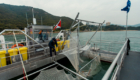
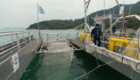
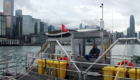
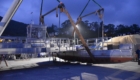
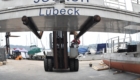
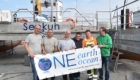
The SeeKuh is the central cleaning vessel of the “Maritime waste collection” and is used in coastal regions and estuaries. In 2016, SeeKuh I was completed in Lübeck and ceremoniously christened. In the meantime, she has had numerous missions in the Baltic Sea, in 2018, in Hong Kong.
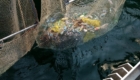
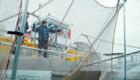
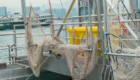
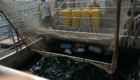
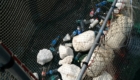
The ship, which is also based on a catamaran design, measures 12 x 10 meters. Between the two hulls are hung specially developed lowerable mesh constructions with meshes of 2.5 cm size. They collect the plastic waste from depths of up to 2 meters. Currently, up to two
tons of garbage can be collected per trip or network.
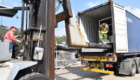
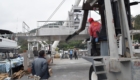
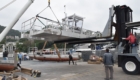
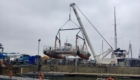
SeeKuh I is the first seaworthy research, cleaning and reconnaissance vessel in the world to be certified by DNV / GL (a type of TÜV for ships). The special ship can be disassembled and stowed in four 40-foot containers. This makes the SeeKuh extremely flexible and allows it to be used worldwide. It is powered by two engines that are still conventional in the prototype. In the future, however, SeeKühe will be powered by solar or wind power.
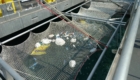
With a speed of up to two knots, the SeeKuh travels practically at a pace on a collective journey. This is not only energy efficient, but also gives larger marine animals the opportunity to escape the net while smaller organisms pass through the mesh.
Apart from collecting plastic waste, water analysis on board is also an important aspect. There is a small laboratory on deck where water samples can be examined directly for plastic using an infrared spectrometer to find out what type of plastic the SeeKuh collects.
Innovative collection concept
In order to clean large areas effectively, oeoo has developed another collection technique, a type of towing device. Two motorized boats, for example local fishing vessels or conventional work boats, pull a SeeKuh with a conveyor belt through the polluted area. Floating barriers are attached between the tuw boats and the SeeKuh. This creates a funnel-like structure that directs the marine debris to the SeeKuh’s conveyor belt.
By working together on both sides of the source of pollution, crossing and the associated stirring up of marine debris
can be prevented. In this configuration, the SeeKuh does not need its own propulsion system.
Circular Explorer
The solar-powered waste collection vessel, formerly known as SeeKuh II, will operate under the name ‘Circular Explorer’ following its official christening on July 21, 2021.
Innovative collection concept
To effectively collect large areas, oeoo has developed another collection technique, a type of towed array. Two motorized boats, such as local fishing vessels or conventional workboats, tow a SeeKuh with a conveyor belt through the polluted operational area. Floating barriers are attached between the tow boats and the SeeKuh. This creates a funnel-like structure, directing the marine debris towards the conveyor belt of the SeeKuh.
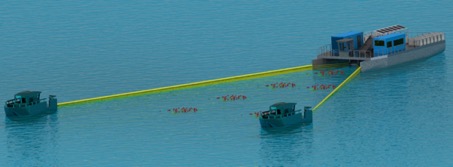
By operating in tandem on both sides of the pollution source, the crossing and associated stirring up of marine debris can be prevented. In this configuration, the SeeKuh does not require its own propulsion.